In 2019, Jan Borowski and Grady Booch, IBM Fellow published a paper on Sky Computing https://www.ibm.com/downloads/cas/EDMYXJ9A to outline some of the concepts and terms, and to recognize the need to better define the future generation of cloud computing.
Sky Computing goes beyond cloud topologies today defined as hybrid, public, private, community, etc with the key goal to focus specifically on the business needs for computing and making computing infrastructure unnoticeable to users.
Sky computing, a dream of yesterday, is an intriguing one that we associate with the idea of extending cloud computing capabilities to airborne platforms such as drones, balloons, satellites and even planes. Hosted on portable optimized computing platforms that can be deployed and redeployed on-demand and that are set up in a networked configuration to provide for needed compute power, scalability, performance and resilience while ensuring security and compliance with most stringent Industry Standards.
Jan Borowski and Darrick Antell, https://lnkd.in/edzMbucc
introduce a vision of a future enterprise that will be autonomously operated by Artificial Intelligence with advanced automation and orchestration technologies.
Autonomous Enterprise is a realization of what would be viewed a fiction just a while ago. It will emerge with advanced AI technologies operating businesses autonomously and humans providing capabilities needed to govern and address all AI-related concerns, such as transparency, explainability, social manipulation through algorithms, privacy, biases, socioeconomic inequality, ethics, loss of human influence, uncontrollable self-aware AI, and anything else what AI can’t fulfill or shouldn’t be accountable for.
The complete paper is available at LinkedIn.
Research paper by Richard Borowski and Arthur Choi, Computer Science Department College of Computing and Software Engineering at KSU.
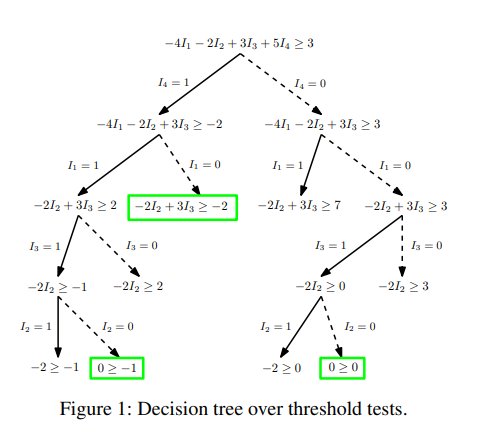
A neuron with binary inputs and a binary output represents a Boolean function. Our goal is to extract this Boolean function into a tractable representation that will facilitate the explanation and formal verification of a neuron’s behavior. Unfortunately, extracting a neuron’s Boolean function is in general an NP-hard problem.
However, it was recently shown that prime implicants of this Boolean function can be enumerated efficiently, with only polynomial time delay. Building on this result, we propose a best-first search algorithm that is able to incrementally tighten inner and outer bounds of a neuron’s Boolean function. These bounds correspond to truncated prime-implicant covers of the Boolean function.
We provide two case studies that highlight our ability to bound the behavior of a neuron.